Why does Boskalis want to source marine sands?
Pls see ‘Why Marine Sands?‘
Simple sand is one of the most important materials needed to support human civilization and economic development. Sand is the second-most-used natural resource globally, after water. Sand is an essential ingredient in concrete, which underpins all forms of infrastructure.
Marine sands are emerging as a more environmentally sustainable alternative to traditional land- and river-sourced sands.
Boskalis Australia is seeking to assist the global transition to a more ecologically sustainable way of meeting the world’s demand for sand, by bringing its wealth of global marine expertise and experience to bear.
Why does Boskalis propose to source sand from Cambridge Gulf?
Pls see ‘Why Cambridge Gulf?’
Boskalis undertook a screening of potential sand-sourcing sites across northern Australia.
Overall, the proposed site in Cambridge Gulf is the best option over the assessed alternatives in terms of net environmental outcomes.
The area is highly dynamic with strong tidal currents (>4 knots), a constantly moving seabed, a permanently dark suspension layer at the seabed, and extremely high natural turbidity levels.
Due to the extreme environmental conditions the area does not host sensitive benthic ecological communities including coral reefs, seagrass beds, sponge beds, macroalgae communities etc, so there is no potential to impact on such communities.
What is the location of the proposed project within Cambridge Gulf?
Pls see ‘Project Description’
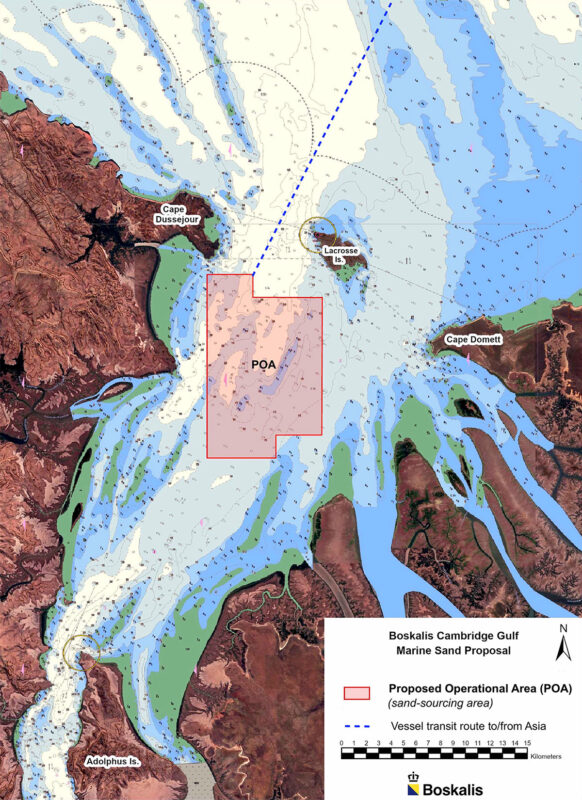
The proposed operational area (POA) is located in the open, deeper waters of the central part of the main body of Cambridge Gulf, south of Lacrosse Island. The POA covers an area of 100 km2, while the overall marine area of the main body of Cambridge Gulf is ~1,900 km2.
The average depth in the POA is -25 m MSL and the deepest depth is -45 m MSL.
The seabed in the POA comprises large sand dunes with highly-dynamic sand waves, with vertical heights ranging from 1 to 8 m and horizontal wavelengths of between 50 and 200 m.
Repeat hydrographic surveys measured horizontal migration of the sand waves over distances of up to 10 m over a one-month lunar tidal cycle.
Where does the sand in Cambridge Gulf come from?
Pls see ‘Project Description’
The sand in Cambridge Gulf is derived from natural land-based sources via river inputs.
It is estimated that 10 to 15 million m3 of sand enters Cambridge Gulf from upstream sources each year.
How much sand is there is Cambridge Gulf?
Pls see ‘Project Description’
Exploration surveys indicate that there is a minimum of 300 million m3 of sand in the proposed operational area (POA), and likely several times more.
This is a small proportion of the total sand volume that is found throughout Cambridge Gulf overall.
How much sand does Boskalis propose to source from Cambridge Gulf?
Pls see ‘Project Description’
Boskalis proposes to export up to 70 million m3 of sand. This is a maximum of only 23% of the minimum volume of 300 million m3 of sand estimated to occur in the proposed operational area (POA), and a much smaller % of the volume of sand that occurs throughout Cambridge Gulf overall.
A minimum of 230 million m3 or 77% of the minimum existing sand resource in the POA will be left in the POA, and likely more.
Does the project include building infrastructure and industrial facilities?
Pls see ‘Project Description’
The proposal does not involve the construction and operation of any marine or shore-based infrastructure.
The proposal does not involve the alteration of the coastline in any way. It will be a 100% vessel-based operation.
How will the sand be sourced?
Pls see ‘Project Description’
The proposed operation will involve a single Sand Production Vessel (SPV), based generally on the design of a large Trailer Suction Hopper Dredger.
What will be the presence of the Sand Production Vessel in Cambridge Gulf?
Pls see ‘Project Description’
The SPV will self-load sand in Cambridge Gulf for one to two days every fortnight. It will then sail to the sand delivery port in Asia and return to Cambridge Gulf two weeks later to repeat the cycle.
This means that the SPV will only operate in Cambridge Gulf for 52 days per year, or 14% of the time. There will be zero operational activity in Cambridge Gulf for 86% of the time during the project’s lifespan.
What is the project life-span?
Pls see ‘Project Description’
The overall project life-span will be up to 15 years from commencement of operations.
However, because the SPV will not be present in Cambridge Gulf for 86% of the time during the project life-span, the actual total time-period when the SPV will be operating in Cambridge Gulf is only 2.1 years, spread over 15 years – allowing significant time for natural recovery processes during the 15-year time-frame.
Will the proposed operation cause negative environmental impacts?
Pls see ‘Environmental Assessments’
Boskalis has undertaken a wide range of environmental, engineering, economic and other studies since 2018. These studies find that the proposed action is feasible and viable and unlikely to cause significant environmental impacts. The full set of assessment reports is available at downloads.
Despite the low likelihood of significant environmental impacts, as a responsible company with stringent environmental and social policies, Boskalis self-referred the proposal under both the WA Environmental Protection Act, and the Commonwealth Environment Protection & Biodiversity Conservation Act (EPBC Act). Both assessments are nearing completion in early 2026.
Will seagrasses, corals, mangroves or other sensitive benthic (seabed) communities be removed or damaged?
Pls see ‘Environmental Description’
Seagrasses, coral reefs and similar sensitive benthic (seabed) communities are not found in Cambridge Gulf, due to the naturally extreme environmental conditions (very strong currents, very high turbidity, highly-mobile seabed sediments etc).
The seabed sand in the proposed operational area (POA) comprised highly-mobile sandwaves, and does not support significant benthic biota.
The proposed sand-sourcing operation will not impact on mangroves.
Will the coastline change due to the sand sourcing operations?
Pls see ‘Environmental Assessments’
Boskalis commissioned three-dimensional (3D) hydrodynamic, sediment transport and coastal process modelling, supported by a comprehensive data collection program, to assess potential impacts on the coastline, including mangroves and beaches.
The modelling is reported in Referral Report No. 8 – Full Modelling Report, [ink to report] and found that potential changes to coastal processes from the proposed sand sourcing are negligible. Potential cumulative impacts were modelled out to 100-years, and were assessed to be negligible.
The modelling assessments were subject to both State and Commonwealth independent, external, expert review. Both reviews found that the data collection program was comprehensive and rigorous, and that the modelling assessments were well calibrated and validated and accurate and reliable
Can fishing continue in the operational area?
Pls see ‘Project Description’
Yes, fishing can continue in the operational area.
The Sand Production Vessel (SPV) will only be present in Cambridge Gulf for one- to two-days each fortnight. There will be zero operational activity in Cambridge Gulf for 86% of the time during the project life-span.
When the SPV is present in Cambridge Gulf, it will operate over a restricted area, will operate at a very low speed (~2 knots), and will comply with normal navigational safety regulations and rules of the road.
What will be visible in Cambridge Gulf during the project and after the project ends?
Pls see ‘Project Description’
During the project life-span, the Sand Production Vessel (SPV) will be visible in the central part of Cambridge Gulf for one- to two-days each fortnight.
Nothing at all will be visible in Cambridge Gulf for 86% of the time during the project life-span.
After the project ends, nothing at all will be visible in Cambridge Gulf, as the project does not involve any marine- or land-based infrastructure.
Does Boskalis propose any measures to protect the environment?
Pls see ‘Environmental Protection Measures’
Boskalis proposes to implement best-practice environmental protection measures to further prevent and mitigate potential environmental impacts from the proposed sand-sourcing operation. These measures will be included in the proposed Environmental Management Plan (EMP) for the project.
The environmental protection measures are based on relevant State and Commonwealth guidelines and long-proven, internationally-accepted measures that have been applied to dredging projects globally.
Will there be economic and social benefits for the local community and for Western Australia?
Pls see ‘Economic & Social Benefits’
The proposal will generate significant economic benefits and employment opportunities for both WA and the local community, in excess of $550 million,
including for Traditional Owners (TOs) in the Wyndham area.
Has Boskalis consulted with Traditional Owners about the proposal?
Pls see ‘Recognition of First Nations’
Boskalis Australia recognizes both the Balanggarra peoples and the Miriuwung-Gajerrong peoples as the traditional owners and custodians of their respective parts of the area. Boskalis is working closely with both Balanggarra and Miriuwung-Gajerrong to ensure that there are no potential impacts on indigenous values and interests, and to develop partnership arrangements for their beneficial involvement in the project.
Please also see Referral Report No. 3 – Traditional Owner Matters.
Has Boskalis consulted with other stakeholders about the proposal?
Pls see ‘Consultation’
Boskalis’ consultation process is ongoing, with further meetings planned, including with local stakeholders and with Traditional Owners (TOs), in early 2026.
From mid-2022 Boskalis undertook a concerted stakeholder consultation effort, as reported in Referral Report No. 6 – Consultation.
Consultation requirements are also set under the WA EP Act and the Commonwealth EPBC Act, and opportunities for public input also included what is required by those Acts.
Should the project proceed, Boskalis proposes to establish and support a Stakeholder Reference Group (SRG), to operate throughout the life of the project.